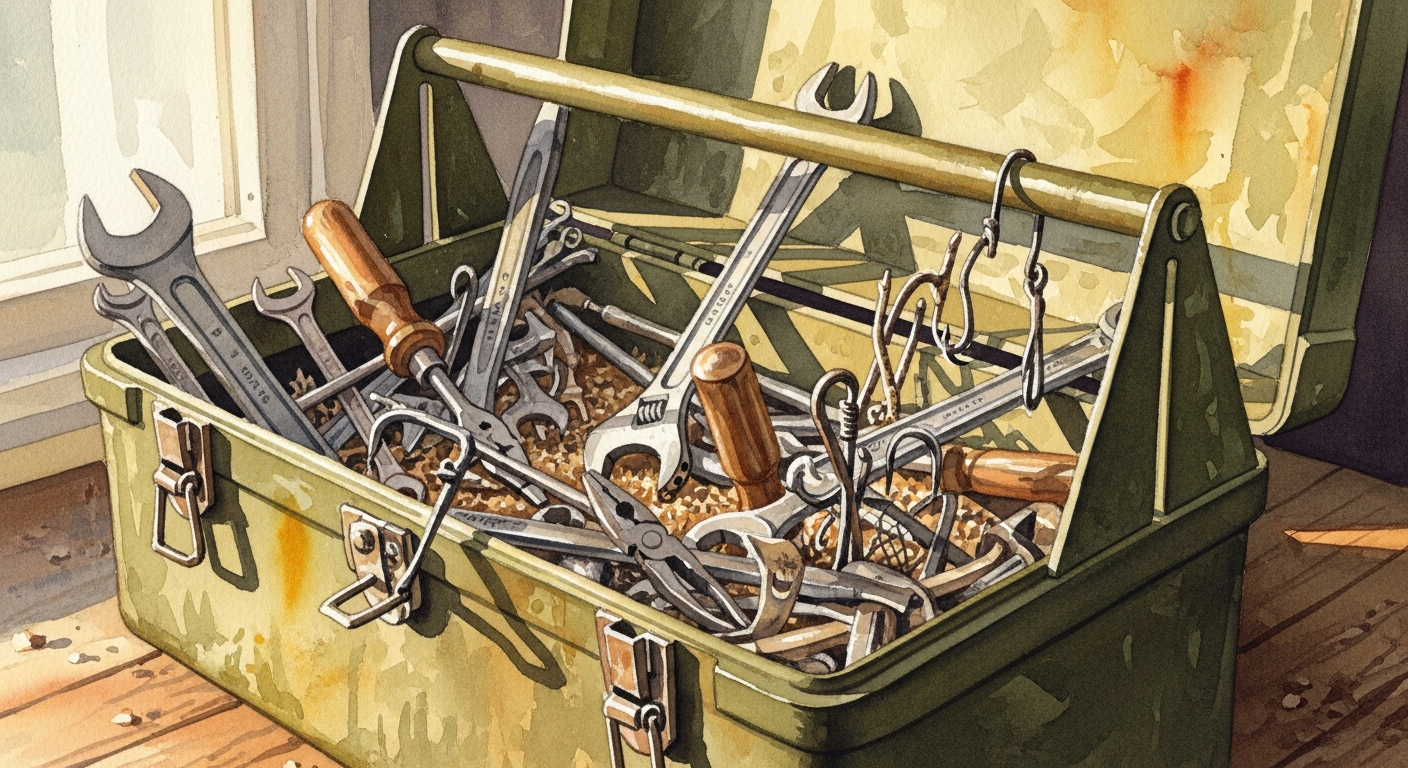
Uncle Jim’s toolbox wasn’t just a toolbox; it was a testament to decades of fixing, jury-rigging, and generally getting things done in a small town where you couldn’t just order a specialist for every little thing. It was a dented, army-green behemoth, its lid clanging like a misplaced cymbal as he wrestled it open. Inside, a jumble of wrenches, screwdrivers, pliers, and more esoteric instruments lay nestled in a bed of sawdust and forgotten fishing hooks. The air around it smelled faintly of oil and old metal, a scent as much a part of the bait shop as the earthy tang of worms in the back room.
AI-generated illustration — chill style
He rummaged, a low hum escaping his lips, a sound I’d heard countless times when he was deep in thought. Marie and I stood a respectful distance away, leaning against the counter, watching the show. My own mind, usually spiraling with what-ifs and future anxieties, felt strangely calm, focused entirely on the brass box sitting on the chipped laminate. The idea of its hidden contents, of a story waiting to be unlocked, had effectively quieted the usual static.
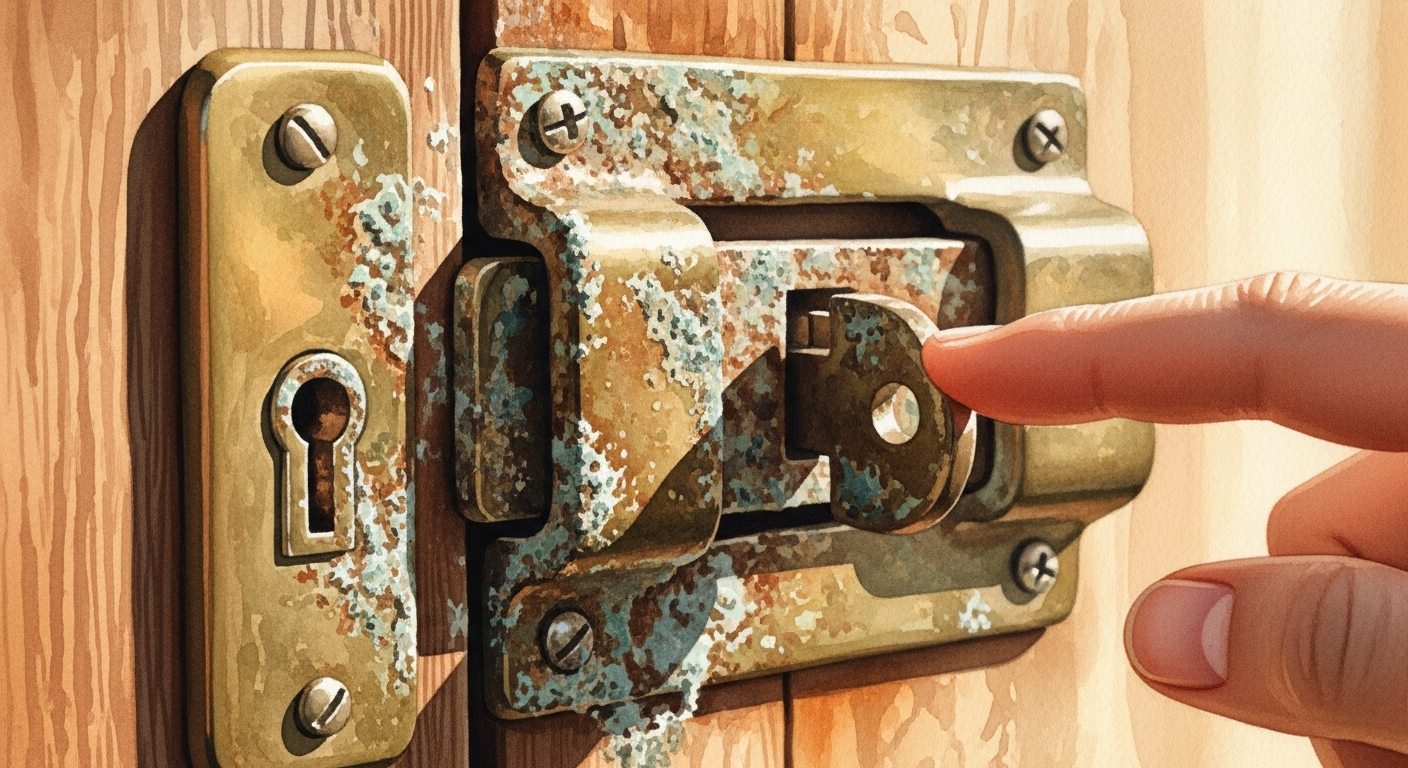
“Alright,” Uncle Jim finally grunted, pulling out a handful of thin, pick-like tools and a small can of WD-40. He set them down beside the box with a soft thud. “This ain’t gonna be pretty. Rust is a stubborn beast.” He gave the box a critical once-over, then focused on the small, tarnished lock mechanism. “Might be a simple wafer lock, or something nastier. Old stuff sometimes had clever traps.”
He dabbed a bit of the lubricant onto the pinhole and around the edges of the latch, letting it seep in. The smell of the WD-40, sharp and chemical, momentarily cut through the bait shop’s usual aromas. Time seemed to stretch, thick and slow, like molasses in January. This wasn’t a quick YouTube hack; this was the patient, deliberate work of someone who understood the language of metal and rust.
Marie nudged me with her elbow. “Look at you, Mr. ‘Summer of Nothing.’ Already deep into a full-blown mystery.” Her grin was wide, her eyes sparkling with amusement. She was still chewing on that same piece of grass, I noticed, or maybe a new one.
I just shrugged, a genuine smile pulling at my lips. “Can’t help it. It’s got a good hook.” I gestured vaguely at the box. “Besides, this counts as productive idleness, right? We’re not doing anything strenuous.”
“Uh-huh,” she drawled, unconvinced but letting it slide. She knew me too well. The simple act of observing Uncle Jim, of waiting, was already a step removed from true ‘nothingness’ for someone wired like me. And honestly, I wasn’t fighting it. The low hum of a distant barge out on the river, a familiar, chest-vibrating rumble, felt less like a reminder of the world passing by and more like a gentle soundtrack to our unfolding quiet drama.
Uncle Jim selected a thin, curved pick, his calloused fingers surprisingly deft as he inserted it into the tiny pinhole. He worked with a meticulous concentration, his brow furrowed, occasionally adjusting his grip, his ear almost pressed to the box. We could hear the faint, delicate scraping sounds as he probed the mechanism, a series of soft clicks and whispers that were almost imperceptible over the general drone of the shop’s ancient fluorescent lights.
Minutes ticked by. Five, ten, then fifteen. The initial excitement of the discovery had mellowed into a quiet anticipation, a shared moment of focus. I found myself studying the intricate carvings on the brass, tracing the swirls and lines with my eyes. They weren’t just decorative; they hinted at a story, a purpose, a journey. The brass, under the dust and tarnish, had a rich, deep glow, suggesting quality craftsmanship that had endured.
“Stubborn old bird,” Uncle Jim muttered, withdrawing one pick and trying another, thicker one. His patience was remarkable, a stark contrast to my own inner clock that was always trying to speed things up. “Someone didn’t want this opened easily.” He paused, squinting at the pinhole. “Or maybe they just wanted to protect whatever’s inside from the river.”
That thought sent a fresh ripple of intrigue through me. What kind of secret was worth protecting from the relentless current of the Missouri? Not just from petty thieves, but from the very river itself, with its slow, powerful embrace of all things lost.
He tried a different approach, a gentle jiggling, a slow, deliberate twist. There was a faint, almost imperceptible thunk from inside the box, a sound that made both Marie and I subtly lean forward.
Uncle Jim pulled the pick out. He looked at the box, then at us, a small, knowing smile playing on his lips. “Almost had it. It’s rusted, but it’s not seized. Just needs a little more coaxing. And maybe a bit of heat.” He pushed himself away from the counter. “Be right back. Got a torch in the back room.”
My ‘Summer of Nothing’ was officially taking a detour involving precision tools, lubricant, and a blowtorch. I couldn’t help but laugh, a genuine, unburdened sound. Marie just shook her head, still grinning. “I told you, Leo. Nothing is harder than doing nothing.”
“You were right,” I admitted, my eyes still fixed on the heavy brass box. “And I’m kind of glad.”
The fluorescent lights above hummed, their buzz suddenly more prominent in the quiet. Marie leaned against the chipped laminate counter, picking at a loose thread on her cutoffs. “Glad? You just admitted your grand plan for utter oblivion is now a treasure hunt with a blowtorch.”
I shrugged, a smile still playing on my lips. “Yeah, but it’s a slow treasure hunt. A methodical one. It’s got a rhythm to it, you know? Like watching the river, but with a potential payoff besides just watching the current carry another lost flip-flop downstream.”
She snorted, chewing on the piece of grass she’d pulled from her pocket. “Right. A flip-flop with secrets. What do you even think is in there, anyway? Jewels? Old pirate maps? A petrified Ernie’s mystery meat sandwich?”
That last one made me laugh. “Gross. Probably not jewels, this isn’t that kind of movie. Maybe old letters. Or something from the river itself, like Uncle Jim said.” I ran a finger along the cool, tarnished brass, tracing the worn, intricate patterns. They looked almost like stylized waves or perhaps some ancient, forgotten script. The weight of it, even just sitting there, felt significant. It wasn’t some flimsy trinket. It was built to last, to hold something important.
The idea of something preserved from the river was particularly intriguing. The Missouri was a greedy beast, swallowing all sorts of things – barges, old cars, forgotten dreams. To pull something back from its embrace, something protected, felt almost defiant. What kind of secret could withstand that kind of long-term submersion and still be worth keeping? It wasn’t a question I would have bothered asking a week ago. A week ago, I would have been too busy trying to figure out the optimal angle for maximum hammock time, or mentally mapping out my pre-college packing list. Now, my mind felt… lighter. Engaged, but without the usual panicked rush.
A minute later, Uncle Jim returned from the back room, a small propane torch in one hand, safety goggles in the other. He slid them onto his nose, the reflective lenses giving him a slightly alien look. “Alright, let’s see if we can persuade this fella.”
He set the box carefully on a worn-out rag on the counter, then aimed the torch’s small, bright blue flame at the lock mechanism. The hiss of the propane and the soft roar of the flame filled the bait shop, momentarily drowning out the distant barge hum and the fluorescent lights. A faint, metallic smell began to waft through the air, subtle at first, then growing sharper, like old copper warming in the sun. He moved the flame slowly, methodically, not lingering too long in one spot, his concentration absolute.
“Doesn’t want to overheat it,” he explained, his voice low, as if talking to himself more than us. “Just expand the metal a tiny bit, loosen up any rust in the pins. It’s a delicate balance.”
Marie and I watched, mesmerized. The brass, where the flame touched it, began to glow faintly, a dull reddish-orange that quickly faded as Jim moved on. He worked with a surgeon’s precision, his large, calloused hands surprisingly gentle, almost coaxing the heat into the stubborn mechanism. It was a testament to his innate understanding of how things worked, of the hidden physics that governed even the most resistant of objects.
The smell of warm metal intensified, mixing with the usual bait shop odors of oil and old minnow water. It was a strangely comforting blend, a scent of industry and history. This wasn’t some urgent, dramatic heist; it was a slow, respectful negotiation with an old, unyielding object.
After a few minutes, Uncle Jim turned off the torch, the hiss dying down, leaving a ringing silence in its wake. He carefully set the torch aside, then picked up a small spray bottle of lubricant, giving the lock mechanism a few squirts. The liquid sizzled faintly against the warmed metal, carrying away a wisp of steam.
“Give it a moment to work,” he said, pulling off his goggles and rubbing his eyes. “Then we’ll try again.”
The anticipation was almost unbearable, yet also strangely peaceful. My heart wasn’t racing with anxiety, but with genuine curiosity. This wasn’t a problem to be solved, but a story waiting to unfold. My ‘Summer of Nothing’ was morphing into something unexpected, something that, paradoxically, was helping me achieve a rare state of calm. It turns out, sometimes the best way to do nothing is to get completely engrossed in something else entirely.
The air tasted like sunscreen and impending doom. Okay, maybe not doom. Maybe just… change. Big, scary, college-application-deadline-shaped change.
AI-generated illustration — chill style
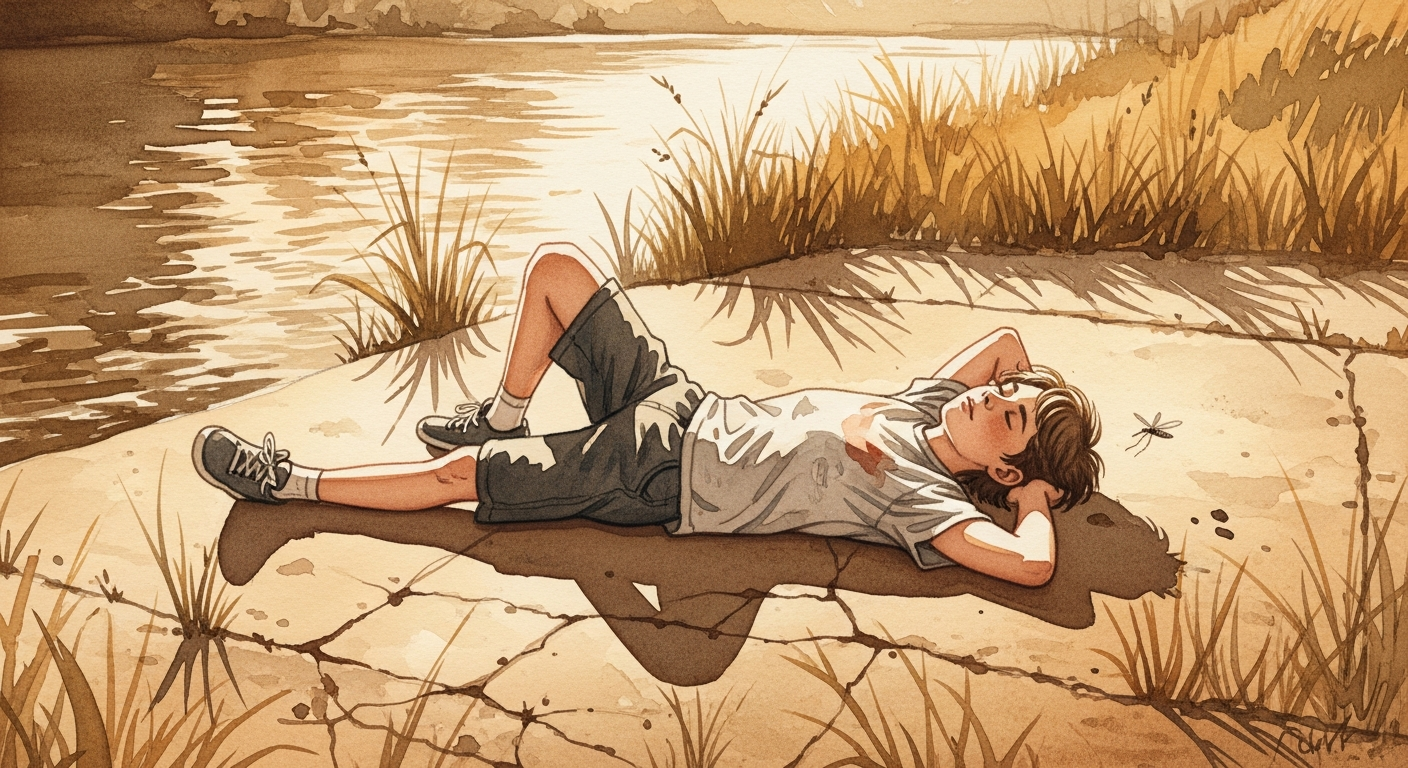
I was sprawled on the cracked concrete of the boat ramp, staring at the Missouri River. Brown and sluggish, it looked like chocolate milk someone had left out in the sun for a week. Not exactly inspiring. But it was familiar. Comforting, even. This river had been the backdrop to every single summer of my life. Every scraped knee, every stolen kiss, every half-baked plan to get rich quick.
My name is Leo, by the way. And this was supposed to be the Summer of Nothing.
The plan was simple: no responsibilities, no drama, just pure, unadulterated chill. I’d work just enough hours at my uncle’s bait shop to keep gas in my beat-up Civic and maybe buy a new fishing rod. I’d hang out with my best friend, Marie, maybe sneak in a few late-night swims. Basically, I’d squeeze every last drop of small-town, summertime bliss out of these next few months before I had to pack my bags and head off to some sterile, concrete campus hundreds of miles away.
Of course, life rarely goes according to plan. Especially when you’re seventeen and armed with nothing but good intentions and a rapidly dwindling supply of brain cells.
A mosquito buzzed near my ear, and I swatted it away with a lazy flick of my wrist. The sun was beating down, turning the concrete into a griddle. I should probably move. But moving required effort. And effort was strictly forbidden in the Summer of Nothing.
I closed my eyes, listening to the low hum of cicadas and the distant rumble of a barge chugging upriver. It was the kind of sound that vibrated in your chest, a constant, unwavering pulse. The kind of sound that made you feel like you were exactly where you were supposed to be.
Then Marie’s voice cut through the haze. “Dude, you gonna melt into the pavement?”
I cracked open an eye and saw her standing over me, a dark silhouette against the bright sky. She was wearing her usual uniform: cutoff jean shorts, a faded band t-shirt (today it was The Ramones), and a pair of perpetually dirty Converse. Her black hair was pulled back in a messy ponytail, and she was chewing on a piece of grass.
“Maybe,” I mumbled. “Sounds kinda nice, actually. Become one with the river.”
Marie snorted. “You’d probably just become one with the algae. Come on, get up. I brought snacks.”
That was all it took. The promise of sustenance. I pushed myself up, wincing as the sticky heat peeled away from my skin.
“What’d you bring?” I asked, already feeling a little less like human soup.
Marie grinned and held up a crumpled paper bag. “Mystery meat sandwiches from Ernie’s.”
Ernie’s was a local institution, a greasy spoon diner that served up cholesterol bombs with a side of small-town gossip. The mystery meat sandwiches were legendary, mostly because nobody actually knew what kind of meat was in them. Probably a little bit of everything.
“You’re a lifesaver,” I said, grabbing the bag. We walked over to the edge of the boat ramp and sat down, dangling our feet over the murky water.
The first bite of the sandwich was… interesting. Definitely some kind of processed meat product, maybe with a hint of pickle relish. But it was strangely satisfying. And it definitely beat melting into the pavement.
“So,” Marie said, after swallowing a large bite. “Summer of Nothing, huh? You actually gonna try and do nothing?”
I shrugged. “That’s the plan. As much nothing as humanly possible.”
AI-generated illustration — chill style
She raised an eyebrow. “Good luck with that. You’re terrible at doing nothing.”
I knew she was right. I was a chronic overthinker, a perpetual planner. Doing nothing was practically a superpower I didn’t possess. But hey, a guy could try, right?
“You could,” Marie conceded, taking another bite of her sandwich. “But trying implies effort. And effort, my friend, is the sworn enemy of Nothing.”
AI-generated illustration — chill style
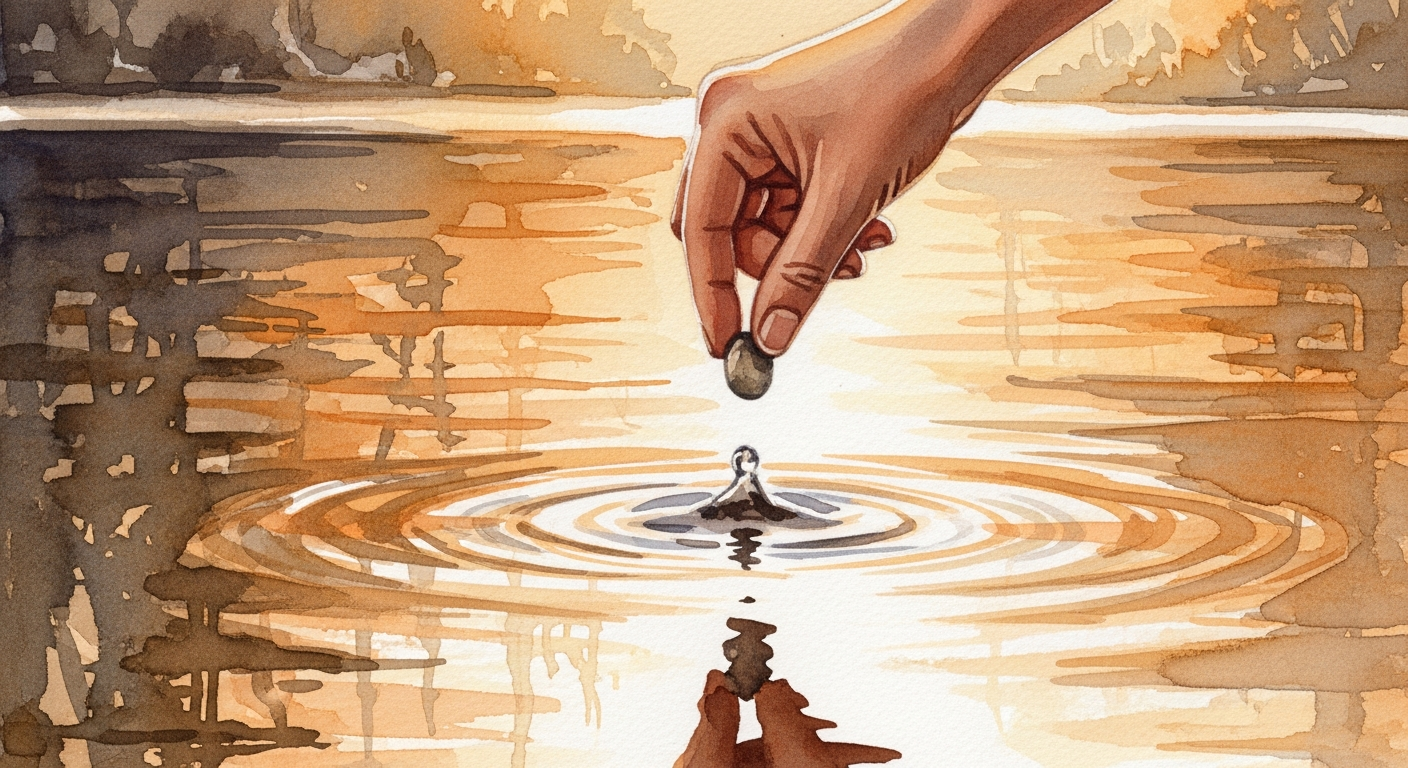
I grinned, tossing a small pebble into the river. It made a barely audible plink as it hit the brown surface, then disappeared. “A minor effort. A tactical retreat. Like a ninja of relaxation.”
She shook her head, a strand of black hair escaping her ponytail and clinging to her lip gloss. She blew it away. “Sure, Leo. Whatever helps you sleep at night. Just don’t come crying to me when you’ve accidentally solved a cold case or uncovered a secret society.”
We sat in comfortable silence for a few minutes, the only sounds the lazy hum of summer and the occasional splash of a fish jumping. The sun was still high, but a thin layer of haze was starting to soften its edges, promising a long, lingering afternoon. I watched a string of barges, a triple threat of rust-colored behemoths, slowly making their way upstream, pushing against the current with a deep, resonant rumble that you felt in your bones. They were a constant on the river, a slow-moving testament to the world beyond our little bend.
My gaze drifted from the barges to the bank directly below us, where the water lapped gently at the muddy shore. Bits of driftwood, discarded plastic bottles, and smooth river stones made up the usual flotsam and jetsam. But something else caught my eye. Just beyond a gnarled root system reaching into the water, half-buried in the wet earth, was a dark, angular shape.
It wasn’t a log. And it definitely wasn’t a bottle.
“Hey,” I said, nudging Marie with my elbow. “You see that?”
She followed my gaze, squinting. “See what? Another one of your existential mud puddles?”
“No, seriously. Over there.” I pointed. “Looks like… a box? Half-buried.”
Marie leaned forward, her brow furrowed. “Huh. You’re right. Looks old.”
It was a small wooden box, about the size of a shoebox, dark with water and age. One corner was visible, a smooth, almost black wood, intricately carved with a pattern I couldn’t quite make out from our perch. It had clearly been washed ashore, wedged against the roots, patiently waiting to be discovered.
“Think it’s empty?” Marie wondered aloud.
“Probably,” I said, but already, the wheels were turning. My “Summer of Nothing” had just hit a snag. A small, wooden, potentially intriguing snag. My hands, which had been contentedly dangling over the water, now felt a faint urge to do something.
“We should go look,” Marie said, already pushing herself up.
I hesitated for a split second. This was exactly the kind of thing that could lead to something. A little mystery. A small adventure. The antithesis of Nothing. But the curiosity was a strong current, pulling me along.
“Yeah,” I agreed, scrambling to my feet. “Wouldn’t want it to float away.”
We carefully made our way down the slick, muddy bank, using the exposed roots and sturdy weeds for handholds. The air grew thicker down by the water, smelling of damp earth and river algae. When we reached the box, I knelt, brushing away some of the mud and wet leaves covering it.
It was heavier than I expected, solid and resistant to my prodding. The wood was dark, almost black, and felt surprisingly smooth beneath my fingertips despite its waterlogged state. The carving was more distinct now: a swirling, almost Celtic-like knot pattern that covered the visible sides. There was a latch, too, made of what looked like tarnished brass, green with oxidation. It was firmly closed.
“Whoa,” Marie breathed, kneeling beside me. “This isn’t just some old junk. This is… fancy junk.”
“Definitely not a tackle box,” I mumbled, trying to wiggle the latch. It wouldn’t budge. “Looks like it’s been down here a while.”
“What do you think’s inside?” Her eyes were wide, reflecting the glint of the brass.
My mind raced. Old coins? A pirate map? A forgotten love letter? The possibilities were endless and, for a moment, completely thrilling. This was it. The first ripple in the placid waters of my Summer of Nothing. It wasn’t some grand, dramatic event, just a small, waterlogged wooden box. But in the quiet expanse of my planned inaction, it felt like an earthquake.
“Only one way to find out,” I said, grunting as I tried to dislodge it from the roots. It was stuck fast. “Help me pull it out.”
Marie grabbed the other end, her sneakers sinking slightly into the mud. “On three,” she puffed. “One… two… three!”
We pulled together, our muscles straining. The box shifted, groaning slightly, before finally, with a squelch and a sucking sound, it came free. We almost tumbled backward, landing with a soft thud on the muddy bank, the heavy box between us.
It sat there, dark and mysterious, dripping river water. The brass latch remained stubbornly shut.
“Now what, Sherlock?” Marie asked, wiping mud from her hands onto her shorts.
I looked at the box, then at Marie, a small grin tugging at the corner of my lips. My summer just got a whole lot less nothing. “Now,” I said, feeling a prickle of genuine excitement, “we figure out how to open it.”
Marie reached for the brass latch again, giving it a tentative tug. It held firm. “Well, that was anticlimactic,” she mumbled.
AI-generated illustration — chill style
I leaned closer, inspecting the mechanism. It wasn’t a simple clasp; it had a small, almost invisible notch where a key might fit, or perhaps a thin blade. The brass was so corroded, it was hard to tell. “It’s seized up,” I said, poking it with a finger. “Probably from being in the river for… who knows how long.”
“Maybe we just need to hit it,” Marie suggested, already eyeing a softball-sized river rock nearby.
“Whoa, hold on. This isn’t some old soda can,” I said, blocking her path to the rock. “It’s old. It’s fancy. We don’t want to smash whatever’s inside.”
“True,” she conceded, dropping her hand. “So, what’s the plan, Brainiac?”
My mind, already whirring, had a few ideas. My dad, before he moved out to god-knows-where, had been a pretty handy guy, always tinkering. He’d taught me a thing or two about stubborn locks. “We need tools,” I declared. “Something thin, to try and work that latch.”
“Like what? A fish hook?” Marie asked, a smirk playing on her lips. “This is your uncle’s bait shop territory.”
“Funnily enough, not a bad idea for a last resort,” I mused. “But something more… robust. Maybe a screwdriver. Or a butter knife, if we can warm it up.” I looked at the box. It was still caked with mud and dripping water onto the bank. “We can’t really do much down here.”
“So, we take it somewhere,” Marie finished for me, nodding. “Where to?”
“My place,” I said, thinking. “Uncle Jim’s bait shop is closer, has all kinds of junk tools. Plus, he usually has some WD-40 lying around.” My uncle Jim was a master of improvisation when it came to fixing things, which mostly involved a lot of lubricant and a bigger hammer.
Getting the box up the slick bank was a minor feat of engineering. It was heavier than it looked, solid and dense with river water. We tried carrying it between us, but the mud made our footing precarious. In the end, we took turns dragging it, the dark wood carving a shallow furrow in the damp earth. By the time we reached the top, our hands were smeared with mud, and my “Summer of Nothing” uniform (a perfectly clean, slightly faded band t-shirt) now bore a distinct brown stripe across the front.
The sun, still high and unapologetic, beat down on us as we trudged towards the gravel path that led back to town. The air felt thick, heavy with the promise of a humid afternoon, a typical Missouri summer day. The box, tucked under my arm for a stretch, felt like a warm stone against my side, a constant, tangible reminder that my plans for blissful idleness were already crumbling.
“This is officially more work than I planned for the entire summer,” I grumbled good-naturedly, shifting the box to Marie, who took it with a slight grunt.
“Imagine that,” she said, a hint of amusement in her voice. “Leo, actually doing something. The world must be ending.”
“Hey, it’s not my fault a mystery box decided to wash up,” I defended, though a small smile tugged at my lips. It was true. I could feel a faint hum of energy beneath my skin, a spark of genuine interest that was oddly… invigorating. The stillness of the morning had been comforting, but this sudden shift felt like waking up from a long, pleasant dream.
As we walked, my mind was already dissecting the box. The wood, the carving, the brass latch – each detail whispered of a story. Where had it come from? Who had owned it? What secret did it hold? The questions piled up, forming a mental tower that overshadowed my previous thoughts of lazy swims and uninterrupted reading. My overthinking nature, once a burden, now had a thrilling new target.
We finally reached the edge of town, the familiar scent of Ernie’s greasy spoon diner wafting faintly on the breeze. The bait shop, a squat, faded building with a hand-painted sign, was just a few blocks away. My Civic, still parked where I’d left it that morning, looked almost abandoned under the harsh sunlight.
“Almost there,” Marie puffed, her hair escaping her ponytail and sticking to her forehead. The box now had a distinct trail of mud across her cutoff shorts.
“Think Uncle Jim will be there?” I asked, picturing my uncle, probably hunched over a tackle box, meticulously organizing hooks or telling tall tales to a couple of early morning fishermen.
“Probably,” Marie replied, adjusting her grip on the heavy box. “He’s always there. Like a really old, grumpy, fish-smelling fixture.”
I grinned. “Sounds about right.” My gaze lingered on the box. The weight of it in our hands, the mystery it promised, felt like a tangible shift. My Summer of Nothing had officially become the Summer of the Mystery Box, and somehow, I wasn’t entirely mad about it.
We pushed open the door to the bait shop, the bell above jingling a cheerful, albeit slightly rusty, welcome. The air inside was cool and damp, a mix of minnow water, damp earth, and a faint, sweet smell of cherry pipe tobacco from Uncle Jim’s ever-present pipe. The clutter of fishing gear, old magazines, and dusty knick-knacks seemed to lean in, as if curious about our muddy arrival.
“Uncle Jim?” I called out, setting the box down gently on the worn wooden floor. Its dark, waterlogged presence stood out starkly against the familiar chaos of the shop.
From the back, I heard a grunt, followed by the clinking of metal. “Leo? You finally gonna earn your keep today?” his voice boomed, deep and raspy. “What’s that you got there, a new pet rock?”
Uncle Jim emerged from a curtained doorway at the back, wiping his hands on a grease-stained rag. He was a man carved from the same stubborn wood as the bait shop itself – lean, weathered, with a permanent five o’clock shadow and eyes that missed nothing, despite often looking half-closed. The scent of stale tobacco, his signature, preceded him, chasing away the faint cherry pipe tobacco smell that usually clung to the corners of the room. He wore waders pulled down to his hips, a testament to his earlier morning duties, probably scooping minnows or cleaning out the worm bins.
AI-generated illustration — chill style
He squinted at the dark, waterlogged box resting innocently on the floor, then at the muddy trail Marie and I had left. His gaze settled on Marie, who shifted uncomfortably under his scrutiny, a stray piece of black hair falling across her face.
“Looks like you dragged half the river in here, kids,” he grumbled, though a flicker of curiosity played around his lips. “What in tarnation is that thing?”
“It washed up at the boat ramp,” I explained, gesturing vaguely in the direction of the river. “Marie found it. It’s got some kind of carving on it, and a brass latch.”
Marie nodded, still catching her breath. “It was heavy. And seriously old-looking. Felt wrong just leaving it there.”
Uncle Jim walked around the box, his thick-soled boots making soft thuds on the worn planks. He bent low, his hand hovering over the dark wood but not quite touching it. His eyes, usually clouded with a lifetime of river knowledge and weary resignation, sharpened. He traced an invisible line over the faint carvings I’d noticed earlier, his brow furrowing.
“Brass, huh?” he muttered, more to himself than us. “Don’t see much brass anymore on river junk. Most of it’s aluminum or plastic these days. Or just plain old rusty iron.” He knelt, a slight groan escaping him, and ran a calloused thumb over the tarnished latch. It was indeed brass, heavily oxidized but still holding its distinctive metallic sheen beneath the grime. The carvings, now that Uncle Jim was examining them, seemed to take on a new significance, swirling patterns that looked less like simple decoration and more like… something else. A symbol? A name? My mind, always eager for a puzzle, began to whir.
“Think it’s worth anything?” Marie asked, ever practical.
Uncle Jim snorted, pushing himself back up with a grunt. “Worth is a funny thing, kid. Sometimes the junk’s worth more than the gold, depends on who’s lookin’ at it. This looks like… well, it looks like it’s seen things. A lot of things.” He patted the top of the box, a surprisingly gentle gesture. “Got a good weight to it too, doesn’t it?”
“Definitely,” I confirmed. “Felt like it was full of rocks, or maybe… lead.”
“Lead, huh?” Uncle Jim mused, walking over to the counter and pulling out a small, magnifying glass from a cluttered drawer. He held it up to the light, polishing it with his rag before returning to the box. He squinted through the lens at the carvings, then at the latch, his lips pressed into a thin line.
“Looks like a lock mechanism,” he finally declared, pointing with the tip of his magnifying glass. “Not just a latch. And it’s set. See that tiny pinhole? Needs a key. Or a really stubborn screwdriver.” He looked up, a glint in his eye. “You want to try and open it?”
My heart gave a little jump. Open it. Of course, that was the next step. My ‘Summer of Nothing’ was officially taking a detour down ‘Mystery Lane’. The idea of a key, a hidden mechanism, fueled the internal narrative engine that was always running in my head. This wasn’t just a random box; it was a puzzle. A story waiting to be uncovered.
“Yeah,” I said, a little too eagerly. “Yeah, I do.”
Marie grinned, sensing the shift in my carefully constructed summer plans. “I knew your ‘nothing’ wouldn’t last, Leo. Too much brain buzzing in there.”
“Alright, alright,” I conceded, feeling a smile spread across my face. “But how do we open it without a key? Think we should try to pry it?”
Uncle Jim chuckled, a dry, rusty sound. “Pryin’s for amateurs, Leo. Might damage whatever’s inside. If you want to do this right, we gotta be smart about it. Let’s see what we can do about that lock. Might be rusted solid. Or it might just need a little… persuasion.” He walked to a different corner of the shop, rummaging through a toolbox that looked older than I was. The Summer of Nothing had officially found its first big something. And I, surprisingly, was okay with that. More than okay, actually. I felt a thrill of anticipation, a genuine, undeniable interest that hadn’t been part of the original plan, but was undeniably welcome.