The hum of the Bridge had become a second heartbeat to Elena Vasquez, a rhythm she now processed subconsciously, her attention consumed by the holographic display. Twenty-three hours had passed since Captain Thorne’s decisive order, twenty-three hours of the Argonaut’s advanced sensor suite feeding raw, unfiltered data directly to her console. She had bypassed the Navigation department’s default AI interpretations entirely, rerouting the primary feeds through a series of custom-built algorithms designed to strip away predictive filtering and present the unvarnished truth. The result was a cascading torrent of information, a digital maelstrom that mirrored the anomaly’s own chaotic nature.
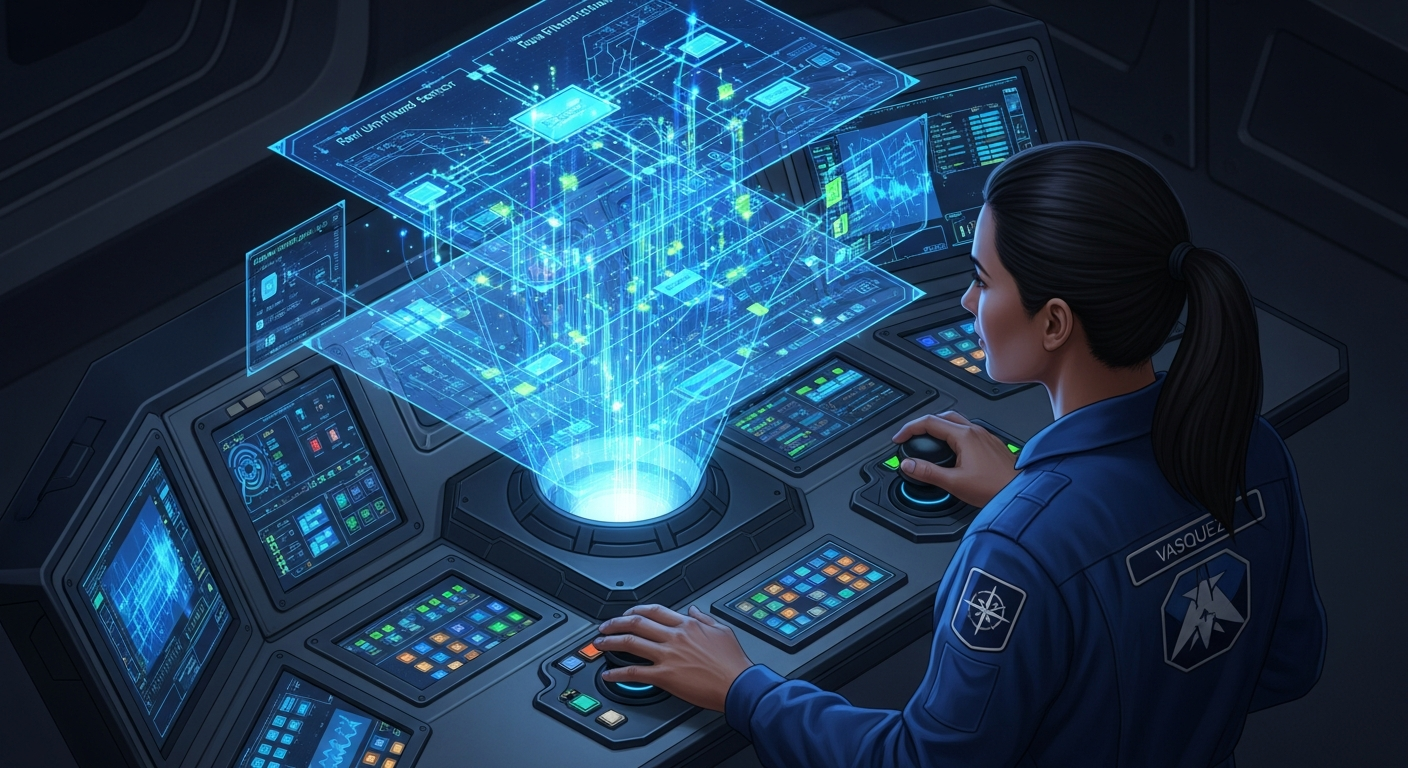
Her fingers, usually still, now tapped a frantic, irregular rhythm against the polished surface of her terminal. The habit, decades suppressed, had re-emerged with the anomaly’s first coherent data burst. It was a physical manifestation of her mind grappling with data that refused to conform, a rebellion against the ordered universe she had always trusted.
The Class 3 anomaly, a swirling red marker on the main viewscreen, now had a more defined, if still utterly perplexing, data aura. The passive scans had given way to active sweeps, pushing the Argonaut’s long-range sensors to their theoretical limits. The gravimetric fluctuations, previously sporadic, now resolved into a discernable, albeit irregular, pattern of localized spacetime distortion. It wasn’t a consistent gravitational pull, nor was it a wave. It was more akin to a series of rapid, transient ripples, as if a pebble were repeatedly skipping across a pond, each skip briefly displacing the water before vanishing.
“Mass properties… indeterminate,” Vasquez muttered, her voice raspy from disuse. Her eyes darted across a dozen sub-screens, each displaying a different facet of the anomaly’s signature. “Gravimetric flux amplitude: 7.2 x 10^-12 G, transient, duration 0.03 seconds, interval variable, non-periodic.” The numbers were precise, yet their meaning remained stubbornly elusive. A mass that winked in and out of existence, or interacted with spacetime in a way that defied the Standard Model.
The electromagnetic signatures were equally baffling. The initial, coherent bursts had intensified, now registering across multiple spectrums – radio, microwave, optical, even a faint, intermittent gamma spike. These weren’t the broadband emissions of a natural phenomenon; they were distinct, narrow-band pulses, sometimes overlapping, sometimes perfectly separated, like complex musical notes played by an unseen conductor.
“Frequency modulation: high. Spectral purity: extreme,” she read aloud, verifying the system’s automated analysis. “Power output: fluctuating between 10^18 and 10^22 watts, mean peak 10^20 W. Directionality: variable. Source convergence… insufficient.”
The Argonaut‘s AI, relegated to a secondary diagnostic role, flagged these interpretations as “Data Incongruity: Extreme.” It was still trying to fit the square peg into a round hole, attempting to match the anomaly’s characteristics to known astrophysical events. Vasquez, however, knew better. Her gut, the irrational instinct she’d dismissed for years, had been right. This wasn’t natural.
She pulled up the raw neutrino data, a feed so clean it was almost pristine. Neutrinos, notoriously difficult to detect, were usually background noise, an energetic whisper from the cosmos. But here, amidst the background, were sharp, anomalous spikes. They didn’t align with any known stellar fusion processes, nor did they suggest particle decay from exotic matter. They were… focused.
“Focused neutrino emissions,” she breathed, a flicker of something akin to awe, or perhaps dread, stirring within her. “Non-thermal. Non-nuclear. Point source, 10 AU off starboard. Intercept vectors confirm.”
Her mind raced, connecting the disparate threads. The sharp EM pulses, the gravimetric ripples, the non-standard neutrino flux. It all pointed to one terrifying, exhilarating conclusion. The flickering, the masking – it wasn’t a random glitch in the fabric of space. It was a deliberate pattern.
This was not a phenomenon. This was a signal.
The implication hit her with the force of a sudden gravitic shift. If it was a signal, then there was a sender. An intelligence. After forty years of sterile interstellar void, the Argonaut had found something. Or something had found them. And the ironclad Argonaut Protocol, designed to ensure survival by ignoring the unknown, suddenly felt like a blindfold, now discarded, leaving them exposed to an entirely new, utterly unpredictable universe. Thorne’s words echoed in her mind: “charting unexplored waters.” She just hadn’t realized how deep those waters truly were, nor what might be swimming within them. Her finger tapping intensified, a drumbeat against the impending dawn of discovery, or perhaps, an omen of the dangers ahead.
Thorne stood silhouetted in the low-light of the bridge, his close-cropped hair catching the faint blue glow from a dormant console. He hadn’t needed to hear the technical specifics; the rhythm of Vasquez’s voice, the shift from detached analysis to a whisper of profound realization, had been sufficient. He walked to her station, the soft thud of his boots on the deckplates breaking the silence that had settled like cosmic dust.
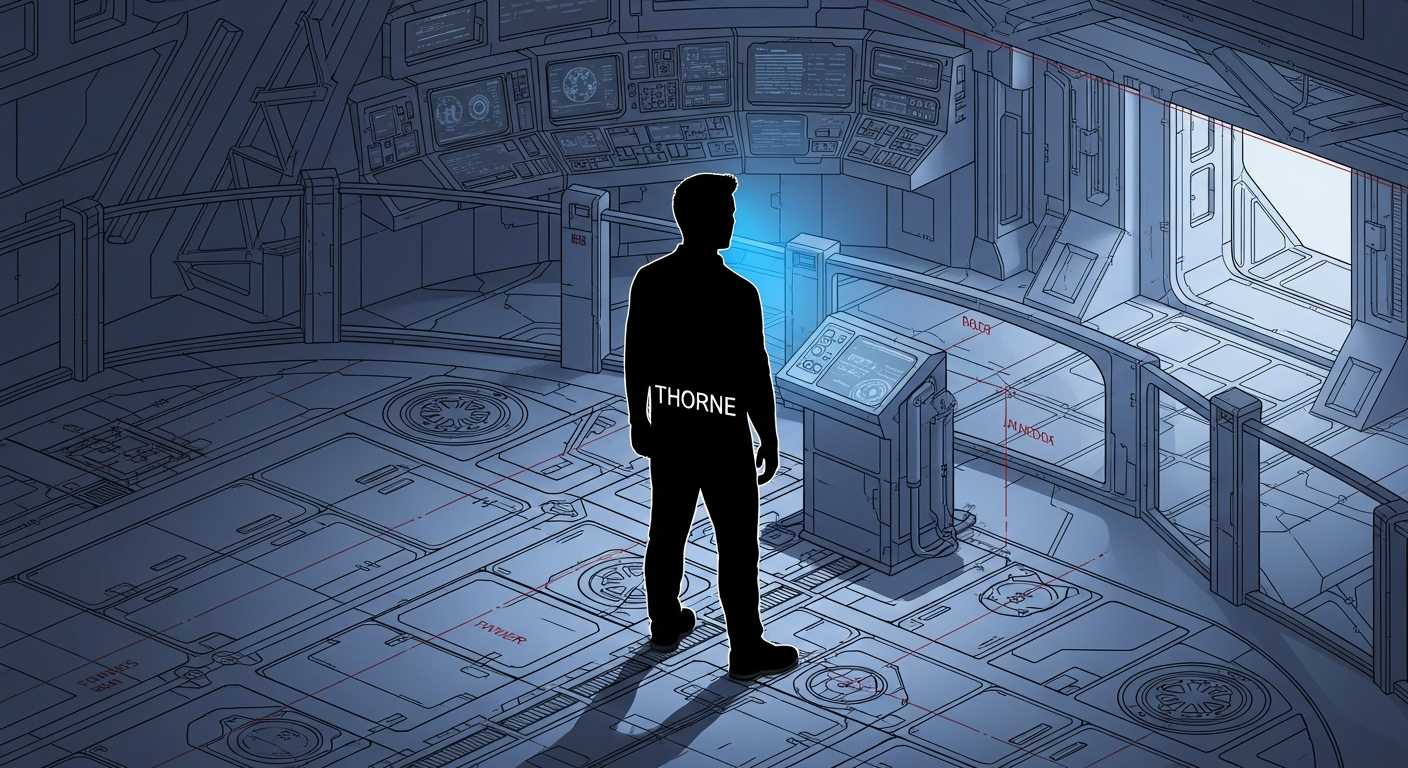
“Elena.” His voice was low, devoid of his usual charming inflection, weighted by the gravity of her findings. “Confirm what you’ve found.”
Vasquez turned, her gaze meeting his, a complex mix of scientific rigor and raw wonder in her eyes. The nervous tapping of her finger ceased, replaced by a tremor that ran through her hand as she gestured to the main viewscreen, now displaying a schematic representation of the anomaly’s inferred structure – not a gas cloud, not a stellar remnant, but a geometric entity composed of the transient gravimetric, EM, and neutrino emission points. It pulsed faintly, a phantom heart in the void.
“It’s not natural, Elias,” she stated, her voice steady now, the pragmatist reasserting control over the awe. “The EM pulses are too coherent, too specific in their frequency and modulation. The neutrino emissions are focused, non-thermal, non-nuclear – they’re directed. And the gravimetric ripples… they’re not merely transient; they’re controlled, masking the entity’s true mass, perhaps even its presence.”
She paused, taking a breath that seemed to pull the recycled air of the bridge deeper into her lungs than usual. “It’s a construct. An intelligence. Whatever it is, it’s capable of manipulating spacetime, generating and directing exotic energy signatures, and doing so with a degree of precision that defies any known physics. It’s not just a signal, Captain. It’s a signature. A deliberate declaration.”
Thorne’s jaw tightened, the familiar lines of responsibility etched deeper around his mouth. He looked at the shimmering schematic, then back at Vasquez. Her intuition, the one she’d distrusted for decades, had cut through the noise of the Argonaut‘s AI, bypassing its programmed limitations to see the truth. The irony was palpable. Their meticulously crafted protocols, their reliance on empirical data alone, had nearly blinded them to the most profound discovery in human history.
“Ten AU,” Thorne murmured, his eyes scanning the navigation data that now pinpointed the source with chilling accuracy. “Just over a day at maximum impulse, if we were… reckless.” He glanced at her, a shared understanding passing between them. Recklessness was no longer a variable; it was the only course of action.
“The Argonaut Protocol is silent on first contact, Elena,” Thorne continued, his voice hardening, shifting from explorer to commander. “Because it was never conceived as a possibility. Our mission was colonisation, survival. Not… this.” He swept a hand across the main screen, encompassing the impossible. “Our mandate dictates ignoring anomalies. We have not just ignored it; we have confirmed it. We have deviated. Irreversibly.”
Vasquez nodded, the ‘shield’ and ‘prison’ of the protocol now fully shattered. “The implications are astronomical, Captain. This entity… it’s not just defying physics; it’s utilizing a physics we don’t comprehend. Its intermittent nature, the way it flickers in and out, the controlled masking… it suggests a level of technological advancement, or perhaps even a form of existence, that is utterly alien.”
“And potentially hostile,” Thorne finished, articulating the dread that Vasquez had only hinted at. “Or indifferent. Both equally dangerous to a vessel like ours, carrying the entirety of humanity’s hope.” His gaze settled on the cryo-vault schematics projected briefly on a secondary display, a silent reminder of the sleeping thousands they were sworn to protect.
“We need to know more,” Vasquez asserted, the scientist in her overriding all other concerns. “We have to understand its purpose, its origin. Is it a probe? A derelict? A living entity? We cannot simply turn away now. Not after this.”
Thorne met her intensity with his own resolve. “Agreed. Turning away is no longer an option. The moment you confirmed an intelligent origin, the parameters of this mission fundamentally changed. We are no longer merely charting unexplored waters, Elena. We are sailing into an ocean we didn’t even know existed, toward something that may be the very definition of the unknown.”
He tapped a command into his console. “Initiate restricted Red-level alert. Route power to long-range sensor arrays, bypass all non-essential systems. Prepare for advanced reconnaissance protocols. Wake Commander Jensen from cryo. We’ll need a tactical assessment.” His expression was grim, but beneath it, a spark of the old curiosity, amplified by the sheer scale of their discovery, burned bright. The awe and dread, Vasquez realized, were not hers alone. They were now a shared burden, and a shared purpose. The journey of the Argonaut had just begun.