The Space Between
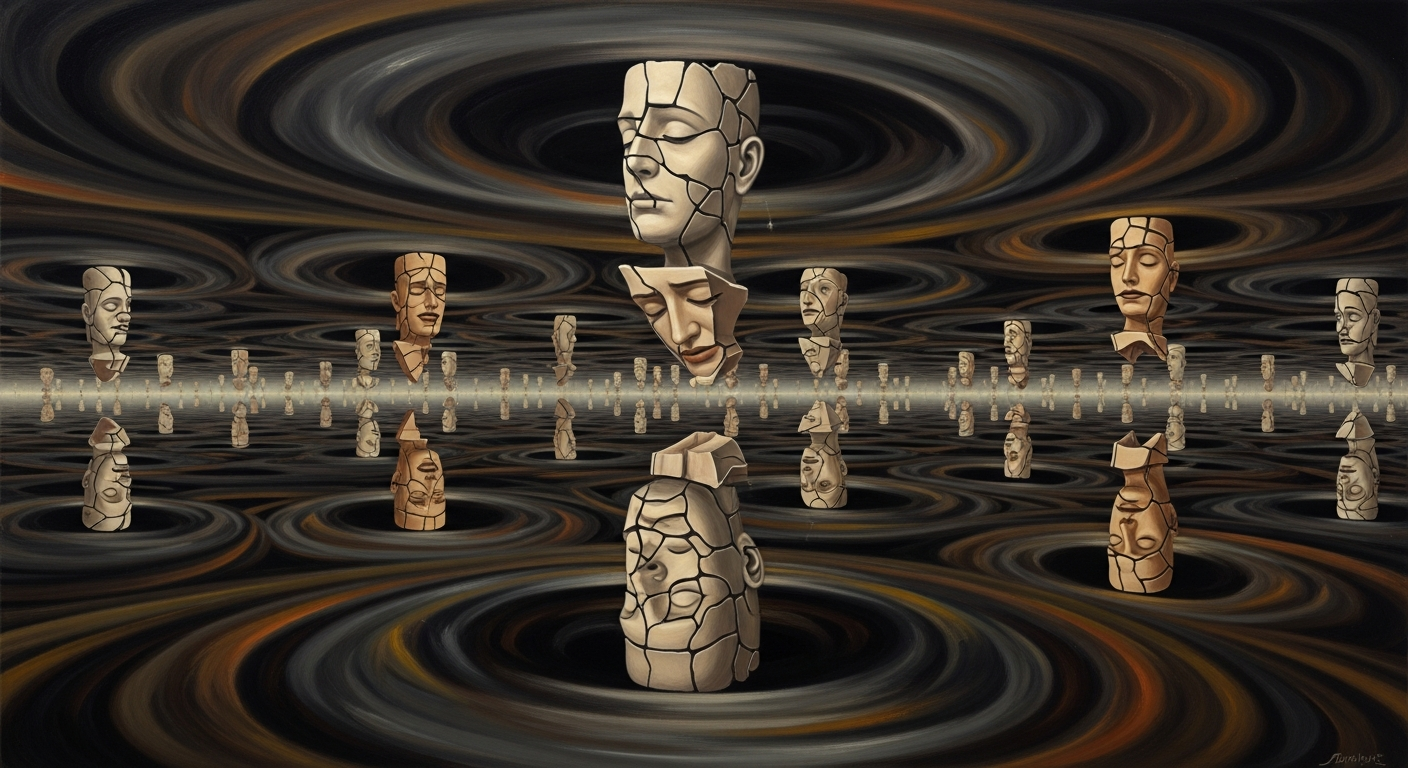
The quiet hum of the West Village brownstone settled around Julianne, a familiar comfort in the interstitial hours between sessions. Days had passed since Elara Vance’s raw revelation, yet the echo of a silent scream, the image of a broken self reflected in an endless dark, lingered. It wasn’t merely the professional imprint of a challenging case; it was the deeper, more unsettling resonance that stirred within Julianne, a sympathetic thrum against the architecture of her own carefully constructed peace. She had noted it then, the mirroring, the profound understanding of a soul exhausted by the ‘ceaseless performance of normalcy,’ and it had only deepened in Elara’s absence.
Julianne spent the morning before Elara’s next appointment in a contemplative state, reviewing her sparse notes from their last meeting. Dream: broken, twisted self, screaming silently. Retreat into formidable defenses. These were not just clinical observations; they were fragments of a nascent, complex narrative, demanding not just interpretation but a delicate, patient engagement. Elara’s fortified wall of guardedness, Julianne surmised, was not merely a protective barrier but a historical monument to past wounds, built with an ancient precision honed by years of practice. It was a structure that could not be dismantled by force, but perhaps, eventually, softened by consistent, unwavering safety.
Her own weariness, that subtle ache in her chest, was a signal she acknowledged without judgment. It was a part of her, a weary exile, perhaps, that identified too readily with Elara’s burden. But Julianne, grounded in the principles of IFS, knew the imperative of maintaining Self-energy. She took a moment, breathing deeply, allowing her own internal landscape to settle. The aim was not to deny the empathy, but to differentiate, to hold it gently without allowing it to subsume her professional presence. She was the anchor, the steady, unshakeable core from which guidance would flow. This was not merely therapy; it was a profound act of witness.
The office, bathed in the soft, diffused light filtering through the tall windows, felt like a silent collaborator. The plush velvet chairs awaited, the carefully chosen artwork offered quiet contemplation, and from the waiting room, the gentle tinkling of the waterfall feature promised serenity. Every detail was curated to whisper of safety, of a space where vulnerability was not just tolerated, but welcomed. For Elara, who had admitted to never seeking help before, this sanctuary had to be a stark contrast to the unforgiving landscape of her inner world.
As the appointed time approached, Julianne felt a familiar blend of anticipation and resolve. There would be no demands today, no overt pressure to revisit the terror of the dream directly. The strategy, refined over years of navigating similar profound resistances, would be one of patient invitation. She would begin gently, perhaps with an open-ended inquiry into how Elara had experienced the week since their last intense session. The goal was to re-establish the fragile connection, to communicate through her presence and her measured pace that Elara remained in control, that this journey was hers to lead.
The subtle sounds of Elara’s arrival—a soft murmur from the waiting room, the click of the outer door—signaled her presence. When Julianne opened the door, Elara stood there, her raven hair a dark frame around her pale face. Her violet eyes, though still holding that profound, characteristic sorrow, seemed a fraction less shadowed than before. There was no wry, self-deprecating smile today, just a quiet, almost hesitant composure. She moved with a certain guarded elegance, settling into the familiar armchair opposite Julianne. Her hands, Julianne noted, were not clenched, but rested lightly in her lap, though a faint tension was visible along her jawline.
Julianne offered a warm, steady smile. “Welcome back, Elara. Come in, make yourself comfortable.” Her voice was soft, even. She waited, allowing Elara to settle, to take in the quiet embrace of the room. The unspoken message hung in the air: You are safe here.
“Thank you, Dr. Moreau,” Elara replied, her voice a low murmur, a little softer than Julianne remembered. She didn’t meet Julianne’s gaze directly, instead fixing her eyes on the Monet lily pond print on the far wall. It was a small, almost imperceptible shift from her previous, more confrontational defensiveness. A crack, perhaps, in the ancient wall, no wider than a breath.
Julianne leaned forward slightly, her posture open, inviting. “It’s good to see you again. How has your week been since we last met?” She kept the question broad, an offering, not a demand. The key was to hold the space, to allow the broken self, screaming silently within Elara, to find its own voice, at its own pace. The journey had truly just begun, and its next step lay in the delicate dance of trust, cultivated with the precision of a master gardener tending to a rare and sensitive bloom.
Elara’s gaze remained fixed on the tranquil water lilies, her silence stretching for a beat too long, a subtle hesitation that was more revealing than any immediate reply. Julianne waited, her own breathing even, her presence a quiet anchor in the room. She understood that silence was often the language of the unsaid, a space where defenses regrouped or, sometimes, began to soften.
Finally, Elara shifted, a slight turn of her head that brought her eyes, briefly, to Julianne’s. “It was… quieter,” she murmured, her voice still low, almost a whisper. “Less… frantic, perhaps.” She paused, as if weighing each word, testing its safety before release. “The dreams didn’t return in the same way. Not the mirror.” A faint tremor ran through her, quickly suppressed, but Julianne caught it, a ripple beneath the surface of her carefully constructed calm.
Julianne nodded gently. “That sounds like a small relief, at least, after the intensity of what you described last time.” She didn’t press for details, merely acknowledged the hint of an easing, careful not to shatter the fragile opening. “And generally, outside of your sleep?”
Elara’s eyes drifted back to the print, though Julianne sensed her attention was now less on the painting and more on her own internal landscape. “The usual performance, I suppose,” she said, a ghost of her old wryness flickering, quickly extinguished. “Though… it felt heavier. As if the effort required to maintain it had increased.” Her hands, previously still, now clasped lightly in her lap, fingers intertwining, then releasing. A nervous habit, perhaps, or a subtle sign of the burden she carried. “It’s exhausting, Dr. Moreau, this ceaseless pretending. I think… I felt that exhaustion more acutely this week.”
Julianne’s own heart gave a small, almost imperceptible thrum of recognition. The ceaseless performance of normalcy. The words resonated deep within her, touching a chord she knew intimately, a weariness she herself had often carried like a cloak. She kept her expression serene, her Self-energy a steady beacon, but internally, she felt the familiar pang of identifying with Elara’s burden, the heavy weight of being a ‘weary exile’ in plain sight. This was where the boundaries blurred, where the professional met the personal, and Julianne had to consciously recenter, grounding herself in the deliberate act of healing, for both their sakes.
“It sounds like a profound weight,” Julianne affirmed, her voice layered with genuine empathy. “And to feel that weight more acutely… that takes immense courage just to acknowledge.” She leaned back slightly, creating a sense of spaciousness, an unspoken invitation for Elara to fill the void with more of her truth, if she felt ready. “What does that acute exhaustion feel like for you? Where do you feel it?”
Elara’s breath hitched almost imperceptibly. She finally met Julianne’s gaze, her violet eyes wide, vulnerable for a fleeting moment, before the familiar guardedness descended like a veil. “Everywhere,” she whispered, her voice barely audible. “In my bones. In my mind. Like a constant hum, a vibration that never quiets. As if… as if I’m always holding something back, always bracing for impact.”
The image of a silent scream, of a broken self, flashed through Julianne’s mind. Always holding something back. Always bracing for impact. It spoke not just of exhaustion, but of an inherent fear, a deeply ingrained protective mechanism. The tension along Elara’s jawline, previously a faint line, now seemed a fraction more pronounced. Julianne understood that to push here, to demand an explanation for the ‘impact,’ would be to risk Elara’s retreat, to re-erect the formidable wall that had begun, however tentatively, to show a few hairline cracks.
“That constant bracing,” Julianne said, her voice soft, exploratory, “it makes perfect sense that it would lead to such profound exhaustion. Our systems aren’t designed for perpetual vigilance.” She kept her hands open, palms resting lightly on her knees, mirroring the openness she wished to cultivate. “Sometimes, just giving that feeling a name, acknowledging its presence, can be a first step. There’s no need to understand it all at once, Elara. We can simply observe it, together.” Her words were an offering, a quiet testament to the sanctuary she was building, stone by painstaking stone, around the fragile, fearful parts of Elara that were slowly, cautiously, beginning to stir.